


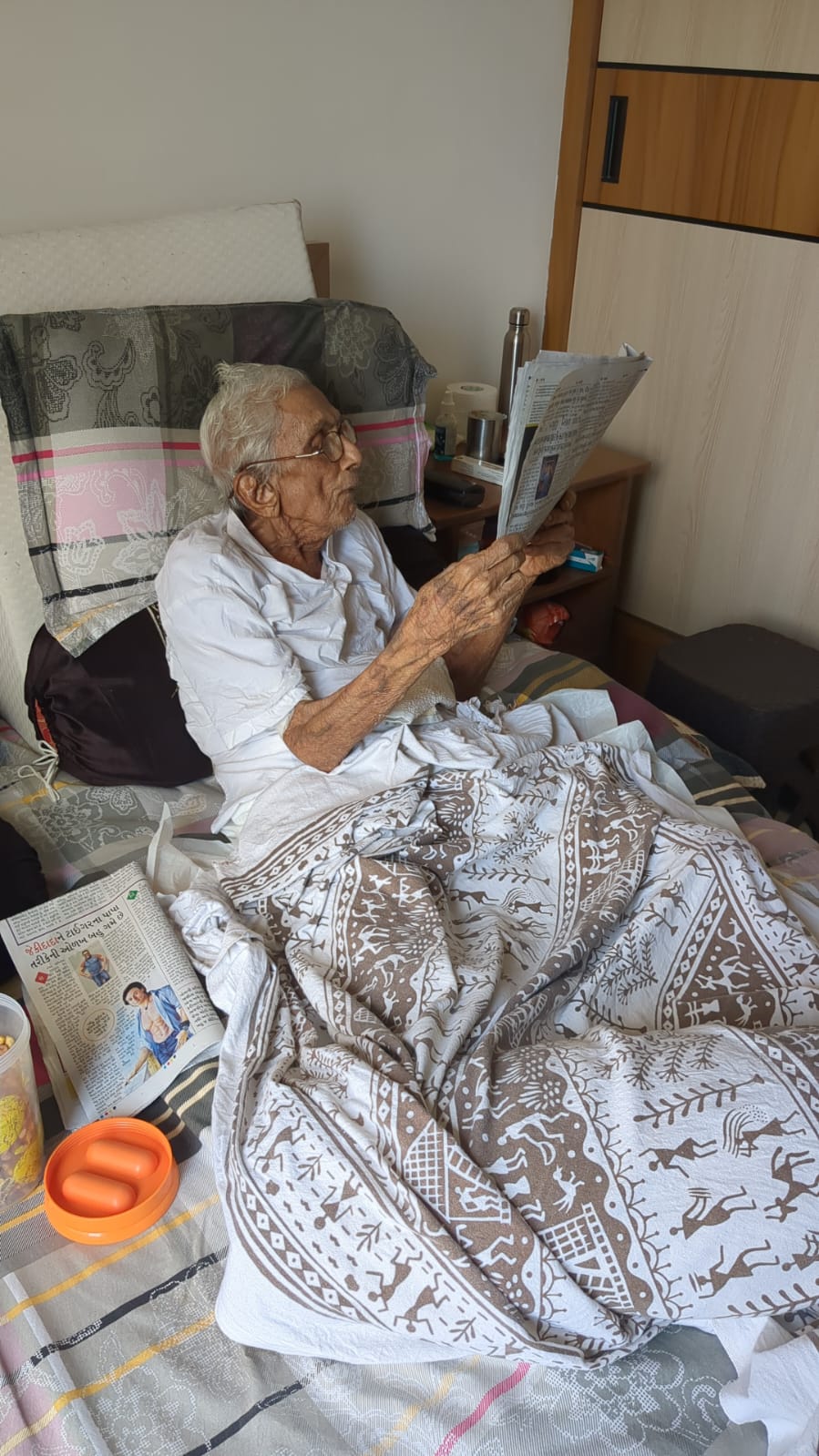
Pune: As Maharashtra’s geriatric population grows, hospitals will increasingly encounter patients in their eighties, nineties, and even beyond 100, requiring complex emergency treatment. The successful surgery of a 101-year-old man at Inamdar Multispeciality Hospital, Pune, following a serious fall demonstrates why advanced age alone should not prevent an eligible patient from receiving appropriate treatment.
The patient had undergone a hip replacement five years earlier after sustaining a fracture of the neck of the femur. Following his recent fall, he was diagnosed with an extensive periprosthetic femoral fracture—a fracture around an existing implant. The injury involved almost the entire shaft of the thigh bone and was accompanied by loosening of the previous hip implant.
His medical condition made the case particularly challenging. At admission, his haemoglobin was only 6 g/dL, indicating severe anaemia, while his oxygen saturation was 93%. These factors, combined with his age and the extent of the fracture, substantially increased the risks associated with anaesthesia, blood loss and postoperative recovery.
After detailed assessment, medical optimisation and blood transfusion, Dr Shivanand Chikale, Dr Anshu Sachdev and their team performed a complex revision hip replacement. The loosened implant was addressed, while the extensive femoral fracture was reconstructed and stabilised using titanium plates and screws.
“Operating on a 101-year-old patient requires us to look beyond the number mentioned as his age. We assess the patient’s overall health, physiological reserve, previous mobility, and the possibility of meaningful recovery. Careful optimisation and meticulous surgical planning allowed us to undertake this complex procedure. With Maharashtra’s elderly population increasing, hospitals must be prepared to manage such cases through coordinated geriatric trauma care,” said Dr Shivanand Chikale of Inamdar Multispeciality Hospital.
Despite undergoing major reconstructive surgery at 101, the patient did not require postoperative ICU care and was stable enough to be shifted directly to the ward. By the second postoperative day, he was able to sit at the edge of his bed. His haemoglobin subsequently improved to 13 g/dL.
“Successful treatment does not end when the surgery is completed. In an elderly patient, preventing complications caused by prolonged bed rest and beginning rehabilitation at the appropriate time are equally important. Our objective is not merely to repair the fracture, but to help the patient regain the highest possible level of mobility, independence and dignity,” said Dr Anshu Sachdev of Inamdar Multispeciality Hospital.
The patient’s family said they were initially apprehensive about whether he could tolerate such a major procedure.
“We were naturally worried because of his age and the complexity of the fracture. The doctors explained the risks and treatment plan clearly, which gave us confidence. Seeing him stable and sitting up within two days of surgery was deeply reassuring. At 101, his determination continues to inspire our entire family,” a family member said.
The case underlines a wider challenge for Maharashtra’s healthcare system. Elderly patients frequently present with fragile bones, anaemia, previous implants and multiple medical conditions. Hospitals therefore require coordinated teams involving orthopaedic surgeons, physicians, anaesthetists, critical-care specialists, blood banks, nurses and physiotherapists.
Chronological age remains an important consideration, but it should not be the only factor determining treatment. The next goal for this patient is focused rehabilitation to help him stand and, if his recovery permits, walk again.