


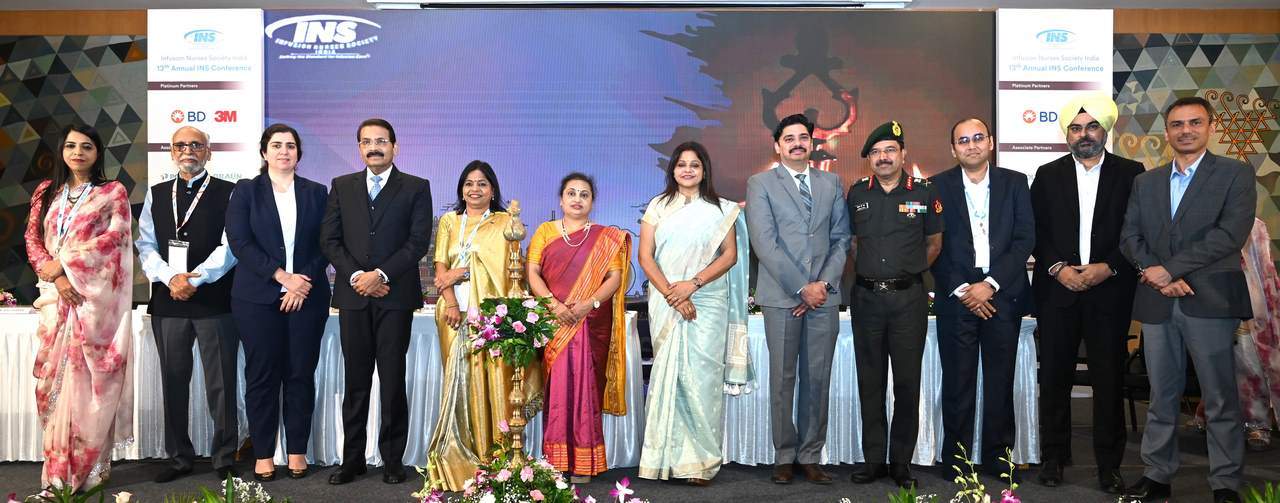
PUNE: As healthcare evolves with technology and advanced vascular access practices, the human touch, clinical excellence, and leadership of nurses remain the cornerstone of quality care and patient outcomes, opined various experts.
The Infusion Nurses Society – India ( INS) Pune Chapter, in association with Noble Hospitals, organised the 13th Annual INS Conference on November 7th and 8th, 2025, in Pune, India, at the Suzlon One Earth venue. The event’s theme was “Lines of Care, Lifelines of Change: Advancing Infusion Practice for a Resilient Tomorrow”. The focus was to advance infusion care, promote nursing excellence, and discuss innovations in infusion nursing through learning and sharing. More than 500 nurses participated in the conference, with around 2000 joining online. The conference was inaugurated in presence of Guest of Honours Lieutenant General Pankaj P Rao, Director and Commandant of Armed Forces Medical College, Dr. Archana Badhe, Registrar Maharashtra Nursing Council, and Dr. Nileema Sonawane, ADHS Nursing, Public Department, Maharashtra, Dr. Vijay Agarwal, President Consortium of Accredited Healthcare Organizations (CAHO) along with Dr. Dilip Mane, Chairman and Managing Director, Noble Hospitals and Research Centre, Natalie Grant Nanda General Manager Business Strategy and Operations, Ruby Hall Clinic and other dignitaries. The organising team included Col. Binu Sharma, CEO -The Infusion Nurses Society – India ( INS), Col. Madhukari Ray, Vice President, Capt. Sandhya Shankar, National General Secretary, Tripti Nanda, Chairperson Organizing Committee, and Co-Chairpersons Dr. Sreelekha Rajesh & Ms Arya Kulkarni.
Colonel Binu Sharma, CEO of INS India, has been the visionary leader and guiding force behind this conference. She designed its foundational structure and guided every stage of planning and execution with clarity, precision, and purpose. Her strategic insight ensured coherence across scientific content, speaker coordination, and overall organization, while her mentorship fostered teamwork and professional growth among all involved. Her leadership stands as the cornerstone of this successful and impactful MEGS event held in the state of Maharashtra for the First time.
Experts at the conference emphasized that infusion therapy, one of the most critical aspects of patient management, demands not only technical precision but also vigilance, empathy, and continuous upskilling.
Chief Guest of the conference and Lieutenant General Pankaj P Rao, Director and Commandant of Armed Forces Medical College, said that giving infusions is one of the most commonly performed functions, but a vital and very important part of patient care, and impacts patient outcome. Managing all this in today’s world with multiple vascular devices, preventing infections, and ensuring that each patient gets well with safety protocols and practices makes the work very demanding. Apart from technical expertise in infusion, one needs to be vigilant 24×7 and pay extraordinary attention to the minutest of details. Hence, what is required is constant practice, upgradation, which makes such conferences very useful. Every line that is inserted, the way it is inserted, every line of treatment represents care, and the outcome gives a new lease of life to the patient. Research, Innovation, advancement, and constant upgradation will make things safer and bring hope to patients as well as medical professionals. While we adopt technology and advancements, human connection will remain the key.
Talking about the incredible transformation of nurses, Dr. Vijay Agarwal, President Consortium of Accredited Healthcare Organizations (CAHO), said that nurses should take leadership in healthcare.
Dr. Archana Badhe, Registrar Maharashtra Nursing Council, said that every nurse is not just a caregiver but also a leader, teacher, and lifesaver. Every life we connect, every drop we infuse, every hand we hold carries not just medicine but hope, strength, and healing. By empowering nurses with skills, we are not just empowering the system, but we are transforming lives. Your compassion brings dignity to care, discipline brings structure to healing, and dedication brings hope to the families. At Maharashtra Nursing Council, we are committed to nurturing that spirit with education, innovation, and integrity.
She added that at the Maharashtra Nursing Council, I am privileged to lead a remarkable force with two lakh registered nurses in Maharashtra, including 20000 dedicated govt nurses working in hospitals and health centres across the state. Each of the nurses represents the heartbeat of the healthcare system.
Dr. Nileema Sonawane, ADHS Nursing, Public Department, Maharashtra, said that continuous skill development with hands-on training is extremely important. She invited the society to have a hands-on workshop for nurses.
Dr. Dilip Mane, Chairman and Managing Director, Noble Hospitals and Research Centre, said that whenever I go on a round, I look at two things: one is the face of the patient, which reflects the improvement or deterioration in health, and the other is the IV line, which is just not the infusion line but a lifeline. This is vital for patients. Referring to the accreditations like JCI, NABH, and others, he said that we have always given importance to quality care, and nurses have a critical role to play in this aspect.
Col. Binu Sharma, CEO The Infusion Nurses Society – India, ( INS) said Infusion is something which every single patient admitted requires peripheral IV line, critical patients may also need complex lines like central line, arterial line etc, patient on dialysis require catheter, patients undergoing chemotherapy may require hickline and a chemo port which means infusion therapy is most critical when comes to managing patients. Many of these lines are inserted by nurses or managed and maintained by them. So, with rthe ight knowledge and practice, hands-on skills are important for safety of patients. The vision of the society is to provide internationally benchmarked clinical guidelines, which means an infusion standard of practice to doctors and nurses, and also to provide knowledge and a hands-on skill-based platform so that nurses can be trained to provide safe and outstanding services and experiences to patients for infusion.
She added that INS India has 17 chapters across the country with more than 5000 members, all nurses.
Delivering the welcome address, Capt. Sandhya Shankar, National General Secretary, INS, said that Infusion is no longer about IV lines and devices, it’s about lifelines that sustain recovery, dignity, confidence, and trust of the community who hand themselves over to us. 65% of patients receive infusion in some form or another.
Dr. Divij Mane, Director, Noble Hospitals and Research Center, said that this was far more than an academic gathering; it was a celebration of passion, precision, and purpose, which is the very essence of nursing. In a real sense, this conference, with its topics and participation, has set up a benchmark for future conferences. The conference brought together the very best in nursing, a mind that questions the hearts that care and hands that heal. Our sessions at the conference have reminded us that nursing is not just a profession but a movement that safeguards the safety of the patients, upholds dignity, and shapes the moral fabric of healthcare. It was a privilege to be in a conference amongst the nursing professionals who are confident, competent, and, as always, compassionate. The future of healthcare lies in empowered nurses who are not only skilled professionals, leaders, educators, and more importantly innovators. It is time we encourage nurses to perceive specialities, whether it is precision therapy, whether it is oncology, infection control, etc., because when we nurture specialization, we elevate the entire profession. Nursing is a science, art, and leadership discipline in its own right.