


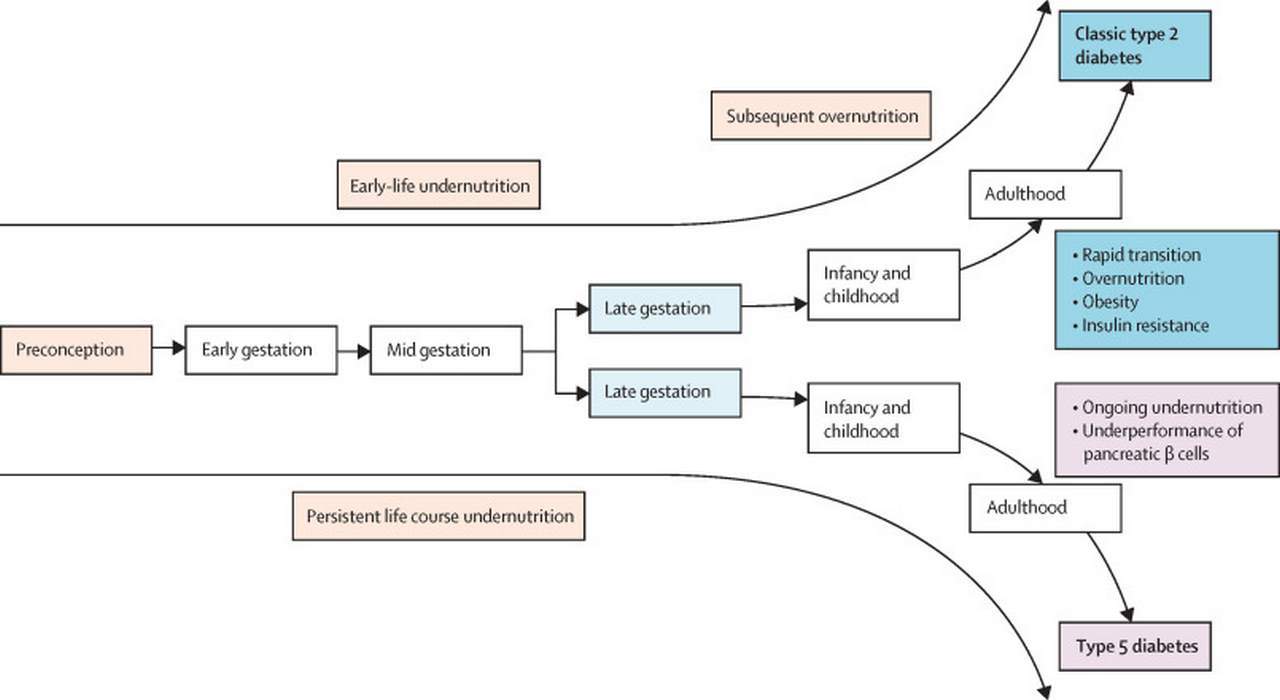
INDIA: A newly published paper in ‘The Lancet’ focuses on an unusual type of diabetes seen in undernourished populations, which needs proper documentation and deeper research to understand its complex causes and the most appropriate treatment. This follows the international consensus meeting in Vellore, India, held in January 2025, where it was called ‘type-5 diabetes’ to distinguish it from the two common varieties of diabetes (type 1 and type 2) and other rare genetic and secondary diabetes. The primary purpose of the new consensus and nomenclature is to attract the attention of multiple stakeholders to this variety of diabetes and encourage further research.
World-renowned Diabetes Researcher and Head of Diabetes Unit of KEM Hospital, Pune, Dr. Chittaranjan Yajnik, who is one of the authors, said that ‘Diabetes is usually equated with overnutrition. But it is reported repeatedly in the last 75 years that many people with diabetes are not over-nourished, obese, or overweight, especially in the developing world. They are either normal weight or lean, or even underweight. This was described as malnutrition-related diabetes. Such descriptions came from predominantly tropical countries and regions like Africa, Jamaica, and India, which have been impoverished for many centuries.
Diabetes is a complex disease caused by both genetic and environmental factors, whose influence varies across different forms. Rare genetic types result from major mutations, but most cases involve a mix of modest genetic risk and significant environmental triggers. Type 1 diabetes, seen in less than 5% of patients, results from immune-driven destruction of insulin-producing cells in genetically predisposed individuals, often triggered by infections, food components, or toxins. It usually occurs in childhood. The most common form, type 2 diabetes, accounts for over 90% of cases and results from the interaction between complex genetic factors and a multitude of environmental influences. The environment is a major driver. Emerging evidence suggests that conditions in the womb—such as poor maternal nutrition, stress, obesity, or toxins—can affect organ development and increase lifelong diabetes risk, a concept known as fetal programming. Both low and high birthweights raise this risk. Indian babies have the lowest average birthweight globally, and are particularly vulnerable. Later life factors like unhealthy diets, inactivity, stress, and poor sleep also raise diabetes risk. Indians are more prone to diabetes at a young age and at a lower BMI. This seems to be due to a unique “thin-fat” body type which results from prenatal undernutrition. Historical deprivation has worsened this trend. The most dangerous scenario to get type 2 diabetes is being born small but becoming overweight in later life. In women, it also raises the risk of gestational diabetes, which in turn increases the risk of diabetes in their children.
Due to varied genetic and environmental factors, type 2 diabetes is highly heterogeneous. It broadly includes all non-type 1, non-genetic, and non-secondary diabetes cases. Sub-grouping based on pathophysiology, complications, and treatment response began in Sweden, with India describing its own subtypes in Pune and Chennai. Unlike Western patients, Indian patients are often younger and thinner. A comparison of sub-groups of diabetes in India (Pune, Ahmedabad, and Assam) with Swedish patients showed that 2/3rds of Indian patients belonged to the relatively thin insulin-deficient variety, while 2/3rd in Sweden were obese and insulin resistant. Persistent lifelong undernutrition in the impoverished populations may lead to what is now called ‘type 5 diabetes’.
The Lancet paper summarises the current concepts that define the characteristics of type 5 diabetes patients. Broadly, they are from socio-economically deprived populations (LMICs and rural communities), have low BMI, are insulin-deficient, and have high glucose levels but do not develop ketoacidosis (unlike type 1 diabetes). On specific testing, they are insulin-sensitive. They do not show the major genetic mutations of diabetes, and their pancreas doesn’t show stones and damage. More research is needed to define the genetic basis of this subgroup.
Such cases of diabetes were called ‘malnutrition-related diabetes’. WHO had accepted it as a separate class in 1985 but withdrew the recognition in 1999 for an apparent lack of crucial data. The International Diabetes Federation recognised type 5 diabetes as a subtype of diabetes during their recent meeting in Bangkok (April 2025) and promoted establishing a working group to further investigate this variety of diabetes. Dr. Yajnik added that this recognition will help improve acceptance of the condition and attract funding for research. India is expected to make a substantial contribution to this activity.
The Way Forward
Type-5 diabetes is not just a matter of nomenclature but a call for action. “If Type-2 diabetes demands that people eat less and walk more, Type-5 diabetes poses novel challenges – these patients are already eating less and working hard,” noted Dr. Yajnik. “There is an urgent need to study its genetic, intrauterine, epigenetic, and nutritional underpinnings, and design treatments accordingly.”
With undernutrition re-emerging globally due to climate change, migration, famine, and conflicts, Type-5 diabetes may assume far-reaching implications. Its proper documentation and research could pave the way for preventive strategies and tailored treatments that address both ends of the nutrition spectrum.
Source- https://www.thelancet.com/journals/langlo/article/PIIS2214-109X(25)00263-3/fulltext