

PUNE:In a rare and high-risk clinical scenario, doctors at Inamdar Multispeciality Hospital successfully treated a 73-year-old woman whose life-threatening respiratory condition evolved into a complex surgical challenge where even a routine life-saving airway procedure became impossible.
The patient was admitted to the Critical Care Unit (CCU) at Inamdar Multispeciality Hospital on 1/3/26 under Dr. Amit Mazumdar with a sudden onset of breathlessness and severe oxygen desaturation following the consumption of outside food. She was a high-risk case, with multiple co-morbidities including morbid obesity, diabetes, and multinodular toxic goiter, and was also diagnosed with pneumothorax.
Initial Management (Date: 4/3/26)
An intercostal drainage (ICD) tube was inserted to manage the pneumothorax. The patient was stabilised and maintained on ventilatory support, with a trial on T-piece conducted after initial improvement.
Failed Extubation Attempts (Dates: 5/3/26 / __)
Despite meeting extubation parameters, two separate attempts to wean her off ventilatory support failed due to persistent desaturation, necessitating re-intubation. The inability to sustain spontaneous breathing raised the need for a definitive airway solution.
At this stage, the treating team explained the need for tracheostomy and thyroidectomy to the family. Given the perceived risks associated with thyroid surgery, the relatives initially consented only to tracheostomy, which was considered semi-urgent.
Intraoperative Turning Point (Date of Surgery: 9/3/26)
During surgery at Inamdar Multispeciality Hospital, doctors encountered a critical anatomical challenge. The patient had a massively enlarged thyroid gland extending retrosternally and completely engulfing the trachea, making tracheostomy technically impossible without first removing the thyroid.
This intraoperative finding necessitated an immediate change in surgical plan. The patient’s relatives were counselled again in real time regarding the urgency and inevitability of proceeding with thyroidectomy.
The surgery was led by Dr. Pravin Bhosale, ENT Surgeon, with support from the general surgery team—Dr. Nelson and Dr. Abhijeet Gotkhinde, while the anaesthesia team comprising Dr. Sandeep Patil and Dr. Jyoti Sawant ensured stable intraoperative management.
Following thyroid removal, the team conducted critical intraoperative assessments. The integrity of both recurrent laryngeal nerves was confirmed, the parathyroid glands were preserved, and there was no evidence of tracheomalacia.
Critical Surgical Decision
Based on these findings, the team made a decisive call to avoid tracheostomy and attempt controlled extubation.
Dr. Pravin Bhosale, ENT Surgeon, said, “This was a highly critical case because what appeared to be a routine need for tracheostomy turned into a complex airway emergency inside the operating theatre. The thyroid was massively enlarged and retrosternal, completely engulfing the trachea, leaving no safe option except to change the surgical plan immediately. In such situations, precise judgment, timing, and coordinated teamwork are absolutely crucial to achieving a successful outcome.”
Post-Operative Recovery (Date: 10/3/26)
The patient’s recovery was notably rapid. She required only two days of CCU care post-surgery. Swallowing function was assessed using bedside FEES (Functional Endoscopic Evaluation of Swallowing), following which all supportive lines and tubes, including Ryle’s tube, catheter, and surgical drains, were removed in a phased manner.
Discharge and Outcome (Date of Discharge: 14/3/26)
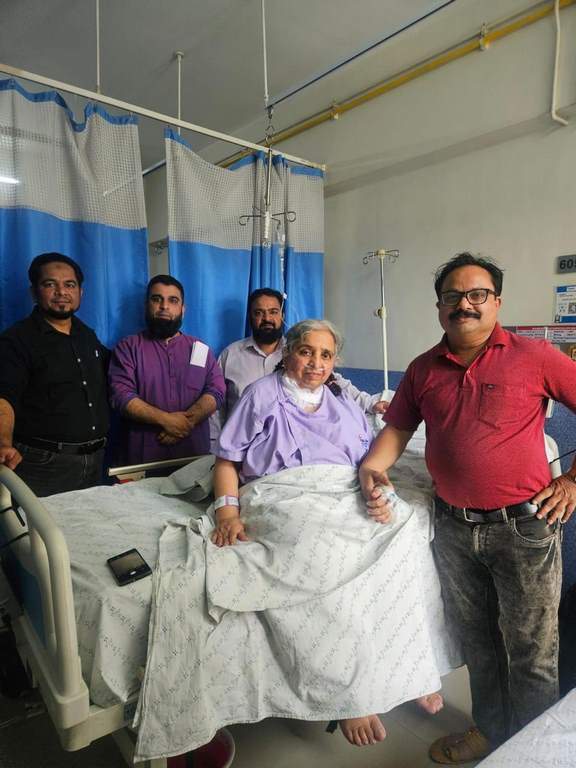
The patient was discharged in stable condition, marking a successful outcome in what doctors at Inamdar Multispeciality Hospital describe as a rare convergence of airway compromise and endocrine pathology.
Reflecting on her experience, the patient said, “I was struggling to breathe, and it was a very difficult time for my family and me. The doctors explained every step and gave us confidence throughout. I feel grateful to have recovered and to be going home.”
The case involved a multidisciplinary effort, with contributions from Dr. Mulla (Endocrinologist), Dr. Ajinkya Gulave, and Dr. Vrushali (Pulmonologists), along with ICU teams, operation theatre staff, and hospital support departments.
Clinical Significance
Doctors involved in the case emphasised that such outcomes depend heavily on real-time intraoperative judgment, multidisciplinary coordination, and the ability to adapt surgical strategy based on evolving clinical findings.