


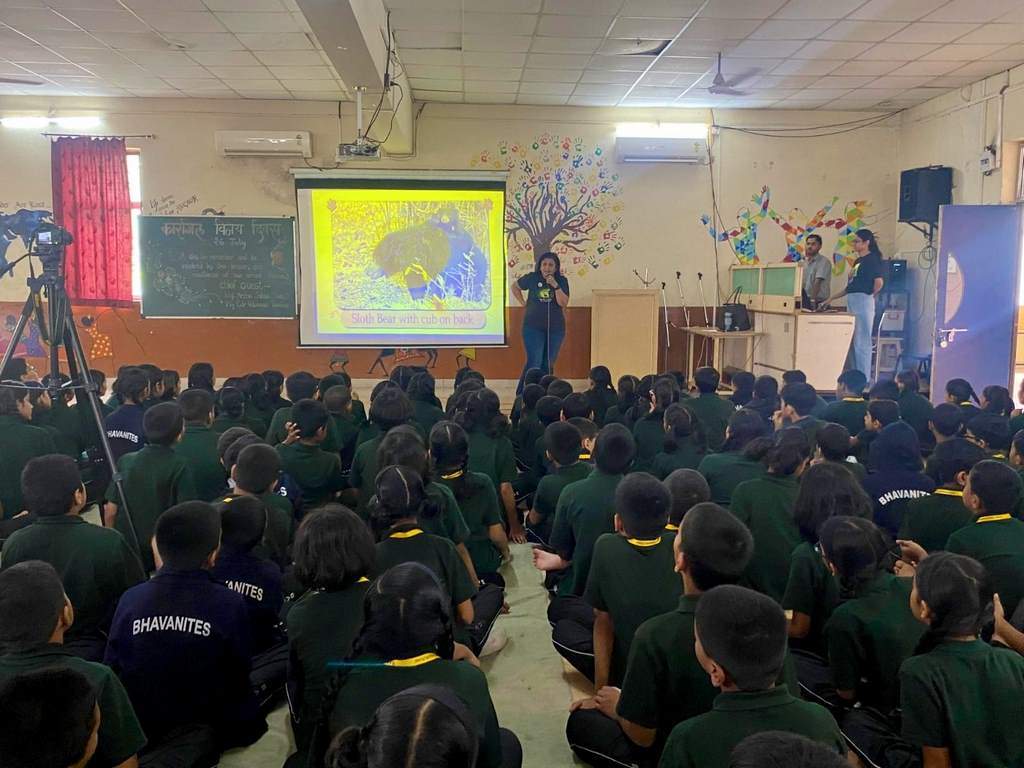
Educational Session for Students Held by Jungle Belles under the ‘Supermom of our Forests’ Initiative
PUNE: In celebration of International Tiger Day today, the Pune-based Jungle Belles hosted a special awareness session for school students under their initiative ‘Supermom of our Forests’ at B.V.B. Paranjape Vidya Mandir K.M. Munshi Kaladalan, 4th Floor, Kothrud, Pune, to introduce children to the remarkable lives of tigresses and to foster a deeper understanding of wildlife conservation.
Paranjape Vidya Mandir’s Secondary Headmistress, Smita Ranjekar, Primary Headmistress, Abhijata Chavan, Teachers of 5th and 6th standards of Paranjape Vidya Mandir, Hemangi Vartak, founder of Jungle Belles, Sanjay Deshpande, Madhulika Tijare, Saurabh Chavan, Parth Salunke, Siddhesh Sonawane were present at the occasion.
Hemangi Vartak, through stories, visuals, and interactive discussions, brought to life the struggles and strength of the tigress, the top predator and arguably the most powerful mother in the forest.
She introduced the audience to some of India’s most iconic tigresses, including Chhoti Tara and Maya from Tadoba, Junabai from Tadoba Buffer, Mataram from Pench, Mausi Ma from Sanjay Gandhi National Park, K-Mark from Kolara, and others like F2 and Fairy from Umred Karandla. Students were shown photographs of these tigresses and learned fascinating facts about their lives, territories, and cubs.
She explained that a tigress usually lives for about 14 years. In her lifetime, she gives birth to 4 to 5 sets of cubs, with 1 to 5 cubs each time. Her pregnancy lasts around 3 months, and she takes care of her cubs for nearly 2.5 years. She raises them all on her own, without help from the male tiger. The tigress hunts, protects, and feeds her cubs by herself. This is why she is truly a ‘supermom’. She survives and raises her family using only her instincts and strong willpower.
The session also shed light on the conservation efforts of the Indian government, particularly Project Tiger, which has been active since 1973. Vartak explained how modern tools like GPS collars, mobile apps, and camera traps are now used to monitor tiger movements and ensure their safety. She also discussed measures such as forest patrolling, the creation of safe buffer zones, and community education in villages near forests.
Students participated eagerly, asking questions about tiger behavior, conservation, and how they could contribute to protecting wildlife. The session concluded with a message of hope and responsibility: that every young person can be a part of preserving the majestic tigress and her home in the wild.